
Interviews
Interviews,
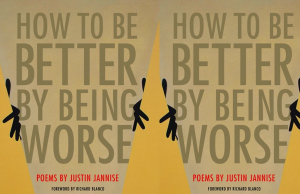
An Interview with Justin Jannise: On How to Be Better by Being Worse
Justin Jannise’s first book of poetry, How to Be Better by Being Worse, was selected by Richard Blanco as winner of the 2019 A. Poulin, Jr. Poetry Prize. While reading it, I was delighted by the way the poems braved emotional, intellectual, and social dilemmas with deftness, wit, and vulnerability. I had questions for Justin […]

Interviews,
The Feminine Mystique: A Micro-Interview with Kathy Bruce
Tapadas, Saints and Other Heroines is the winning work in Visual Art for the 2019 Editor’s Prize contest. In this microinterview, Caroline Frost and Tapadas artist, Kathy Bruce, meditate on the relationship between humans and the natural world, historical archetypes of women, the female form, and Kathy’s artistic influences. In her artwork, Kathy Bruce explores […]

Interviews,
Playing with Space: A Micro-Interview with Tennessee Hill
“I’ve been writing 24/7 for the last 5 years in various academic programs. It’s a total change of pace to focus on myself, my life, my people, and my joy outside of the production and validation of publishing and writing. My project is me!”

Interviews,
On Love, Identity, and Family: A Micro-Interview with Chloe Vassot
“I feel very lucky to be a new writer in a time where there are so many great examples of queer writing. I don’t think it really affects what I do or don’t want to write about. What drives me is confusion and the want to understand. Luckily I’m confused by lots of things, so there’s lots of material!”

Interviews,
Mant Bares speaks with Alain-Jules Hirwa about her story “Lady Sings”
“The story started at the beginning, with the bug that turns out to be a star. I was in Greece with my now-husband, on the island his family is from, and you can see just about every star in the sky out there, along with every bit of refuse burning up in the atmosphere.”

Interviews,
Mateo Askaripour Speaks On Breaking into the Literary World with Black Buck
When I was thrown into the world of literature, and I started meeting people, it was strange, right, because a lot of people are grinding and hustling day to day, but I was hustling and grinding to just get on and not to make rent. But then came the thought of like, I’m doing a disservice if I’m not talking about the importance of making bread as an artist, especially as an artist of color. This is the fucking game—they don’t want us to talk about how much we’re getting paid for advances.

Interviews,
“How Did This Get Made?”: Our Nonfiction Editor in Conversation with Jill Sisson Quinn
“I think it’s always hard to take edits. It feels like someone is cutting off your limbs.”

Interviews,
Horror Vacui & Filling the Negative Space: A Conversation with Artist Nick Perry
Local enthusiasts at community art events in eastern Kansas may recognize Nick Perry’s illustrations as similar to those of Red Legger Studio. Given his pseudonym, it’s fair to assume Perry is part of a collective, yet, Red Legger is a one-man-show. In 2010, fresh out of school with an arts degree and deciding how to […]