A Conversation with Clark Finalist Kiran Desai
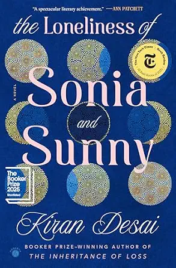
Booker Prize-winning author Kiran Desai returns after nearly two decades with The Loneliness of Sonia and Sunny, her third novel. Following a fiction writer and a journalist whose paths cross in India and the United States, the book traces love’s mutations across continents, modern and traditional family formations, and national boundaries, asking whether loneliness is the price of freedom. In this conversation, Kiran addresses the novel’s inciting questions– how she wove its braided narratives together, why she let magic and mysticism enter a seemingly realist narrative, and which writers, from Isak Dinesen to Kawabata, shaped the work.
LS: The Loneliness of Sonia and Sunny centers one relationship, but each primary character’s secondary romances—with Ilan and Ulla, respectively—are so beautifully developed that either one could carry a novel. Indeed, you’ve said that you initially wrote many of your characters’ stories (including Sonia and Sunny’s) separately, without knowing in advance how they might intersect. Was this book always going to be theirs?
KD: The book was always going to be a book about the many different types of romantic relationships, of marriages and divorces, that populate our modern world. In Sonia and Sunny’s lives, these would include arranged marriages like the ones of their grandparents, semi-arranged marriages of certain relatives and friends, the more modern relationships of their parents, and finally their own experimentations in a much larger, looser landscape. I had thought all the stories could carry equal weight, but something about imposing the form of a novel upon an ocean of stories, demanded that Sunny and Sonia’s unresolved romance would become the way to connect all these other tales into a lexicon of modern day love and loneliness.
LS: English notoriously has one word for “love,” but this novel draws out that term’s prismatic range, addressing not only romance but also community and the often tyrannical bonds of blood. Sonia and Sunny ultimately find a hard-won freedom in each other, but loneliness seems to be its price. In a book about so many kinds of love, how did loneliness emerge for you as a point of emphasis?
KD: The idea of writing about loneliness was in my mind before I realized that one way to write about it might be through the lens of love. I wanted to consider the manifestations of loneliness across the western and non-western world, and in the context of what we consider modern and what we consider traditional. This allowed me to examine the love and loneliness that exist within family bonds across cultures, to examine societal bonds, and also the bonds between nations and citizens.
While the cost of belonging– to love, to community, to family, to nation might be one’s true self, the cost of freedom might be a loneliness so extreme that one becomes a ghost. How to accept that loneliness is the price of what we want to achieve? Perhaps also that it is a decency in a world where there are many claims upon every landscape? Maybe it is also a way to an artistic life that is not subsumed by a familial, national or historical narrative. And secretly, maybe loneliness is a mystical bridge over the divides between us.
LS: Writers are often counseled to introduce speculative or mystical elements early in a narrative. But yours—Sonia’s amulet, Badal Baba, and a white dog that haunts each member of the couple—emerge later. How and when in the process did you decide to complicate the novel’s apparent “realism”?
KD: The narrative followed my own artistic and life experience, as well as the mental and emotional changes in my characters. I was certain, at first, that this novel would be entirely anchored in realism. I was concerned that the beast that haunts the couple would be seen as something belonging to “primitive” non-western cultures, although I believe all cultures are rooted in magic. Yet we are weaned from wonderful childhood stories into believing in realism and rationality. But somewhere down the line, life teaches us otherwise. We are all, at one point or another, thrown out of ordinary life. Some grief or trauma puts us in a realm where we might think we have encountered an incarnation of the devil, we watch others go about their rational lives while we are suddenly fighting fears that have demonic strength. We live with figments, phantoms, we notice coincidences that are not coincidences. We experience a strong sense of the unseen world.
Sonia is thoroughly thrown out of ordinary life in her relationship with Ilan, so is Sunny when he is haunted by the murders of his uncles, when he, as a journalist, begins to see the demonic links of history unfolding. How can they know if a ferocious hound is a real-life dog, or a manifestation of a deeper threat? Its sudden appearance mirrors their nightmares.
Lindsay: A well-known risk of braided narratives is that one thread dwarfs the other. Yet long before they intersect, Sonia and Sunny’s stories are equally engaging. How did you achieve that balance?
KD: I am glad you think they are equally engaging. I thought of Sunny and Sonia, and of their respective careers, fiction and journalism, as two wings of the same bird. Essentially, they are variations upon the same being. I was also helped by Sunny’s mother who is so incorrigible a character, I could perhaps see the path to balancing Sonia’s graver storyline.
LS: Were there particular authors you returned to for guidance or inspiration as you wrote this book?
KD: Funnily enough, the authors who most influenced me also led me astray. I loved them too much! I followed them as if they were Pied Pipers, and this eventually required much revision. Isak Dinesan, Angela Carter, Leonora Carrington, are authors I read because they blur the real and the hallucinatory. V.S. Naipaul has always been an inspiration because he has written so well about the existential crises that followed the end of the colonial world. I was influenced by Roberto Bolaño, Maxine Hong Kingston, Michael Ondaatje, Sandra Cisnernos—so many great writers who write about migration. Then there is Yasunari Kawabata who wrote an Asian love story by imbuing the form of the novel with the philosophy of Zen Buddhism. This made me consider how I could try to draw in Hindu and Buddhist ideas of being, and of how the work of mystic poets of India might relate to modern writers of fragmented stories living in New York City.