
A Review of J. D. Wilke’s “The Vine that Ate the South”
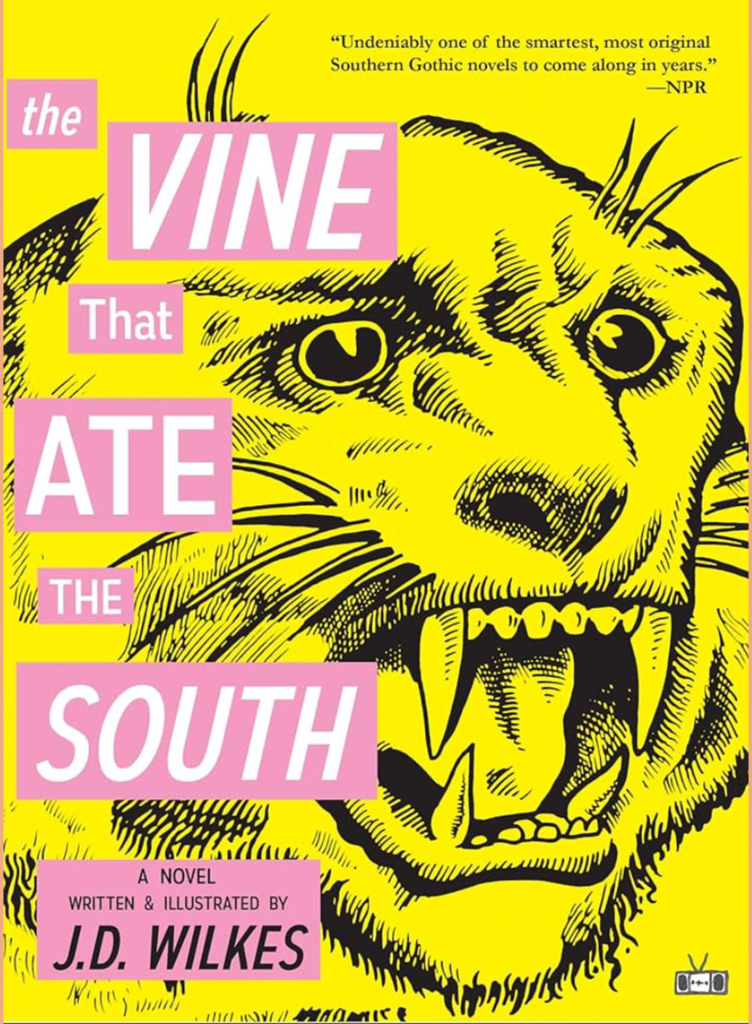
Kudzu and haints. Southern villains so revered that some folks claim to sleep with their windows closed out of fear one of the two might actually suffocate them in their sleep. In J.D. Wilkes debut novel, The Vine That Ate the South, the illustrator and leader of Th’ Legendary Shack Shakers, takes readers down an abandoned red-neck railroad on a quest to put some gospel behind an old country fib.
Down at the drugstore, “where old warriors told ghost stories and old ghosts told war stories,” Wilkes’ unnamed narrator eavesdrops on a bench full of lying old men musing on the tale of a dead elderly couple. As it’s told, the Kudzu was so hungry, it devoured every piece of their flesh and left the bones hanging out in a part of the woods called the “Deadening.” This place is described as, “a horrible hillbilly filigree of dangling belongings and shocking remains,” but the truth is no one’s ever put eyes on these skeletons.
“I am drawn to the forest today,” the narrator proclaims. Readers soon learn of the “Old Spur Line,” a set of abandoned train tracks and the one sure fire path down into the “Deadening.” Carver Canute, the narrator’s older, stronger, “Elvis-haired” friend, who slicks his hair back with pork drippings, also saddles up for the ride. “[Canute] is a good-humored, gear-headed, coon-huntin’ raconteur. A thrill-seeking adrenaline junky who sports leather wrist cuffs and a wallet chain,” we’re told. Canute brings the needed muscle into the equation. The two then set out atop their ten-speeds in search of glory.
It’s a winding railway to the Kudzu House where the elderly couple remain deep in the “Deadening.” There are moments of uncertainty and humor. With a tankful of slapstick, colloquial gasoline, Wilkes’ descriptions give readers enough premium to keep their feet mashed on the pedal as we travel “Old Spur Line.” Reflection and recollection rear their heads from the backseat too, evident by pulling the narrator’s past into focus. His absent father, dead from “the accident,” has a real stranglehold upon his self-worth, and his mother left him undersized in all the wrong places.At points, the awareness of self is crystal with the narrator acknowledging, “Between her smothering and his absence, I was, and still am, lost when it comes to being a young man…” Within the rare instances where the narrator is unable to tote the weight of the story, Wilkes uses Carver Canute to pick up all the needed slack as the confident and strong man that keeps things moving.
Wilkes’ voice is bona-fide, southern Kentucky Fried. The same charm which makes him such a charismatic stage presence is on full display. His greatest strength lies in his love of folklore. He transcends line-and-stanza, to paragraph-and-chapter. Page after page, there is never an inkling of doubt or question of authenticity surrounding the merits of his knowledge about Kentucky, or the south in general. Hell, it’s a story about Kudzu after all—a plant which, despite its horrific reputation, farmers were once paid to plant by the government to keep the soil from blowing away. He’s even provided a map, and illustrations abound to aid the reader in the likely event that one might try their hand at locating the Kudzu House on their own. Tread lightly, however.
Although the “Old Spur Line” is rarely straight, it is one way, enough to confine the search for the elderly couple’s bones. There are several instances, however, where readers are veered into off-course sections . Examples are the Mothman and Curse of Copperhead chapters, where Wilkes hijacks the ride and asks readers to join in on jumping the tracks. It’s here, where a flashback is situated alongside new entities, leaving abrupt, unresolved conclusions. While entertaining, these other, smaller, folk tales add little value to the task at hand, locating the Kudzu House. At best these moments offer another feather to adorn the cap of Wilkes’ ability to command southern folklore. At worst, these chapters can feel distracting and create a wandering narrative which taints the overall quest.
J.D. Wilkes truly delivers in all his southern righteousness. He’s not called the Colonel of Kentucky for nothing. The Vine That Ate the South is an enjoyable, whimsical, rock-n-roll read with themes as wide as the state itself. Repercussions of benevolence collide with the bygone and extant as the Kudzu parades through the pages, nudging readers to square up with the South and its tangled past. Wilkes takes aim at the plant’s historical significance, turns it on its head and gives it all a great big middle finger. He shows rural hillbilly Kentucky from a stance few have seen and with arrogance to boot. Even those unfamiliar with the south and the southern gothic genre can find some parallax to common tropes here. From a ghastly vine, dead bodies, and cemeteries, to upending faith and reconciling demons of the past, it’s all here. Sandwiched between two buns, deep fried,wrapped in tin foil laced with LSD, and served hot off a roadside stand deep from the swamps of western Kentucky.