Erasure Poetry: Is There Emotional Risk?
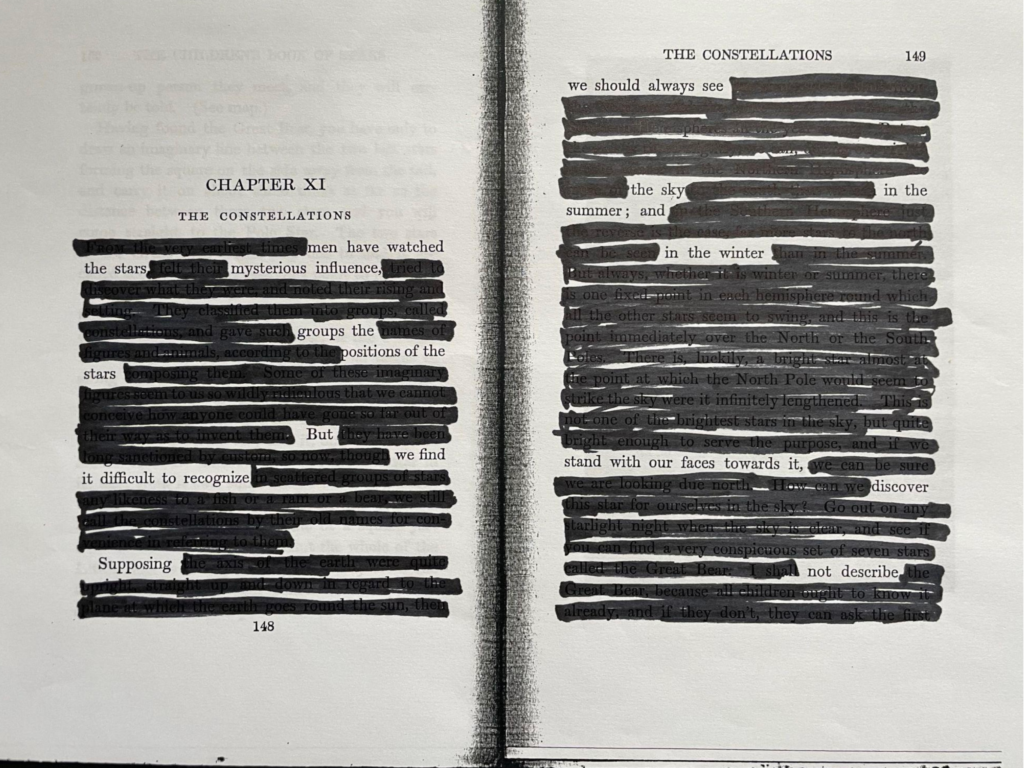
I wrote an erasure poem last week, or rather, I erased an existing text into poetry. This was for a graduate course in Small Poems at Texas State University. After studying works by notable erasurists, we were invited to create our own using source material photocopied from an antique book—The Children’s Book of Stars1—offered to us by our instructor, the poet Cecily Parks.
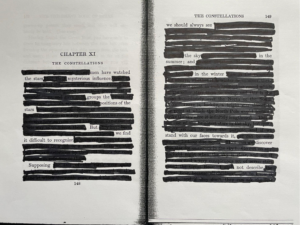
When I finished blacking out the facsimile text with Sharpie, I was pleased with the poem I’d created. It had that poetic quality—the “hyper-present absence” Elisa Gabbert talks about.2 It sounded good! I had pulled poetic significance out of the text, or into it, significance that felt spiritually urgent even!
men have watched the stars
mysterious influence
groups the
positions of the
stars
But we find it difficult to recognize
Supposing
we should always see
the sky
in the summer; and
in the winter
stand with our faces toward it,
discover not describe
I read the poem to my husband Jeff, who is also a writer, and he liked it. I was pleased with myself in the way that people are pleased when they’ve won a game of Backgammon—when they’ve been lucky and clever (attributing most of the win, of course, to their own cleverness). It was impressive precisely because it had come from something prosaic, and if it wasn’t so good, that was equally the fault of the source material.
To be honest, when I encounter an erasure poem, my initial reaction is a hurried inward nod, like—yes, I get it, okay. As if, grasping the concept, I’ve already read and grasped the poem itself. When I actually read it, of course, there’s usually plenty that’s of interest. Though seemingly facile as a concept, erasure poetry in practice and on the page brings up rich intertextual and metapoetical questions about waste, loss, life, survival, authorship, choice, chance, creation, revision, subversion, variation, violence, silence, space, surprise, lineage, art, and existence itself. Anyone wishing to engage with these concepts in conversation with an existing text could find endless inspiration and revelation in the process of creating erasure. Take, for instance, Jen Bervin’s Nets, which strips Shakespeare’s sonnets, leaving the original texts in faded grayscale. Aptly titled, the cycle creates a kind of porous container through which the memory of Shakespeare’s poems can pass, and in reading it one participates in an active dialectic between the familiar sonnets and the bolder, barer text.3
There’s also political urgency to erasure poems when they take on texts that deal with—or perhaps, ignore—racial, sexual, or legal subject matter, for instance. An example is the deeply affecting “The Ferguson Report: An Erasure” by Nicole Sealey, published in The New Yorker, in which the poet redacts the DOJ investigation into police bias and brutality against Black Americans, using vanishing text to reveal her poem.4 As you scroll through the document, phrases like “they say wait so We wait” appear suspended in space.
Academic, moral, and emotional value notwithstanding, when Jeff and I discussed erasure poems, he questioned whether they contained emotional risk. Emotional risk: the element missing from my poem. The easy gratification I felt after writing it was evidence that there was nothing vulnerable of me in the lines I’d created.
There are other kinds of risks involved with erasure poetry, to be sure—erasure can be a transgressive act, especially when it slashes words from a religious text, a political document, or the work of an artist who is still living. Erasure poetry could even end up being literally confessional. Then there’s the artistic risk, too, that your erasure poem could just be very bad, particularly in comparison to the original.
But in terms of emotional risk—coming to the page needing to communicate something directly from your consciousness and laying bare the raw material inside your mind—is this possible in erasure poetry? If you came to an erasure poem with precisely what you wanted to say in mind and then found each word in the text, maybe, but then you’d lose the element of discovery that makes the process of erasure relevant.
Perhaps you could say this of any form of collaboration, translation, or formal constraint. It’s also true that when we compose poems, we’re always pulling from a limited store of words (the stuff of our vocabularies) and that source texts just present a more drastic reduction to that store. Are we ever really pulling words out of nothing, as it might feel when we’re writing, or are we instead always taking dictation from somewhere—if not from the page itself, as with erasure? At what point does the art of selection, of finding the words already on the page, impinge on or preclude finding the words in our consciousness that want expressing, the exact mots justes?
Mary Ruefle describes the process of erasure as her eyes scanning words that hover above the page like a field of flowers waiting to be picked.5 This process can be beautiful, personal, and even mystical. And it’s not as if it’s always easy. You likely still need to have some sense of rhythm and sound in order to pluck the words into a worthy poem.
For the reasons I’ve already listed, I don’t take it for granted that all art has to have emotional risk in order to be rich and meaningful. But if emotional risk is one of the things we come to literature to encounter, erasure poetry might mean its sacrifice in favor of other advantages. Whether this sacrifice is worth it depends on one’s artistic project. As far as my own work goes, as a student of early modern poetry I can see it being a revealing and thrilling way to commune with poets from history. But a poem I scratched out would probably never feel as true to my soul as one I wrote from scratch.
Above all, that easy, self-pleased feeling after finishing a poem is one I hope to avoid.
1 Mitton, Geraldine Edith. The Children’s Book of Stars. London, England; A & C Black, 1910. Project Gutenberg. Web. Accessed
2 Gabbert, Elisa. “The Shape of the Void: Toward a Definition of Poetry.” The New York Times, April 15, 2022, https://www.nytimes.com/2022/04/15/books/review/what-is-poetry.html. Accessed March 6, 2026.
3 Bervin, Jen. Nets. Brooklyn, N.Y. Ugly Duckling Presse, 2004.
4 Sealey, Nicole. “The Ferguson Report: An Erasure.” The New Yorker, July 24, 2023. From the issue of July 31, 2023. https://www.newyorker.com/magazine/2023/07/31/the-ferguson-report-an-erasure-nicole-sealey-poem. Accessed March 6, 2026.
5 Ruefle, Mary. “On Erasure.” Quarter After Eight Journal, vol. 16, 2010, https://ia.eferrit.com/ea/dcf81aca20f61e00.pdf. Accessed March 6, 2026.