“Making a Decent Life in an Imperfect World”: A Conversation with Debra Monroe
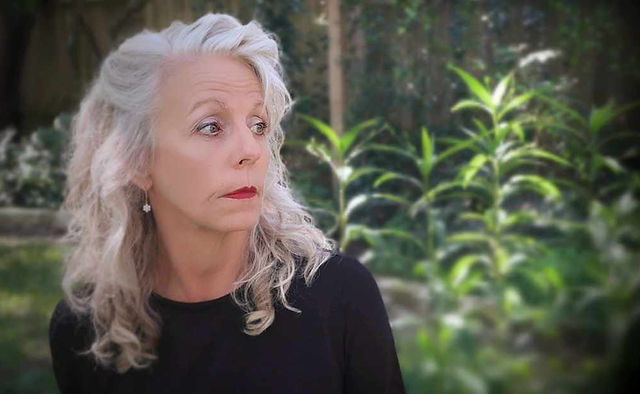
Almost forty years since her first major publication, Debra Monroe taught the last seminar of her career in a small, ground-floor classroom at Texas State University. She posed for a photograph holding an eraser up to the whiteboard, seeming surprised at her own nostalgia.
On a blustery, late April afternoon, we [Zach and Ana] sat down with her at her kitchen table, framed by a series of tall windows. Outside, there were large terra-cotta pots blooming with little red, pink, and white five-petaled flowers, and the falling rain emphasized the lush greenery all around us. The garden, which she takes great pride in, felt like a physical manifestation of a sentiment she verbalized to us later that afternoon: literature is a testament to making a decent life in an imperfect world.
Monroe, who retired at the end of this academic year, has taught creative writing at Texas State University since 1992. In 1990, she received the Flannery O’Connor Award for her debut story collection, The Source of Trouble, and has since published numerous well-regarded novels, memoirs, and books of stories and essays. She has been twice nominated for the National Book Award and has received multiple honors for excellence in teaching and mentorship. As a teacher and workshop leader, she has imparted her profound craft insights and academic rigor to decades’ worth of writers and has modeled a sincere and infectious love for literature in classes that were always engaging and illuminating.
Monroe is a frenetic conversationalist, navigating from one thought to the next with the agile precision of a locomotive barreling through to unexpected destinations. Speaking to her, it’s difficult to forget her classroom anecdote of once having been a child who got scolded for bantering with adults at dinner parties. She is a natural storyteller, a sometimes-slapstick physical comedian, someone for whom an interview is an arena for play as much as it is for revelatory insight about the role of artmaking in the face of life’s indeterminacy and chaos. What follows is our conversation with her.
PHR: What books did you read as a child and young adult? What were some of your early, significant reading experiences? What books or teachers led you to become a writer?
DM: Well, given where I grew up, I had very limited experiences of both. I probably read the same books that most children were reading, like Heidi and Black Beauty. I became a fast reader with high comprehension pretty quickly. There was a tiny library in town and sometimes a bookmobile, and I read through the kids’ sections rapidly. I was always running out of things to read, and my dad would bid on boxes of moldy books at auctions and estate sales. As a result, I read a lot of books from the 1930s and 1940s with brittle pages, little silverfish in the bindings. Like The Robe, such a weird book, or The Good Earth by Pearl S. Buck, a better book. These were bestsellers, sometimes known only the year they were published. I’d read them three or four times because I didn’t have a lot of books. It was an odd mix of old standards and outdated bestsellers.
Apart from books, I was also influenced by rock and roll lyrics at the time. I don’t mean “she loves you, yeah, yeah, yeah” as much as, like, Jefferson Airplane or Bob Dylan, lyrics that were spooky and slightly hallucinogenic. I always had an attraction to the sublime tradition.
I remember trying to read The Autobiography of Malcolm X when I was about twelve. My dad was worried about civil rights and bought it to inform himself. I got further into it than he did. I read pretty much anything. I would read a placemat; I would read the backs of cereal boxes. Reading is essential, right? Every writer was once a kid who was always in a closet or corner, reading.
The teachers who made a difference had a passion for awakening interest in unlikely students. That for sure has influenced my own teaching. I wasn’t considered bright when I was young. I was willfully obtuse about some subjects—until I needed them. By local standards, subjects I liked weren’t useful. They wouldn’t lead to paid work. But good teachers found me or I found them, even in my tiny hometown and at my small college. I had a good creative writing teacher there, a poet, and a Shakespeare scholar with a national reputation. Everyone said he was so hard, that I would never pass. But I was good in that class, surprising myself. It turned out I love Shakespeare. I took that class the same summer I happened to be doing LSD and I still got an A.
PHR: One of my favorite parts of reading It Takes a Worried Woman was getting to learn more about your life as a college student and then a graduate student in your twenties. How did you see yourself as a reader and writer in that period of your life? What texts or themes did you find yourself gravitating towards, and do you feel that this period in your life shaped your later career as a writer and teacher? What do you feel is the role of adolescence or young adulthood in the writer’s life?
DM: Hardly anyone was telling women’s stories then. Classmates, especially at the PhD level were, you know, mostly male. They said things like “you guys (me and the one other woman) need to live a while and find your material.” We were writing women’s coming-of-age stories, as most people in their 20s do. They were writing men’s coming-of-age stories. But these had been treated as literature for centuries. A fiction writer I discovered on my own was Jayne Anne Phillips—her first book, Black Tickets. And the poet Diane Wakoski. They were intense, unapologetically female, a little tough. They were also writing about women with sexual autonomy, not a “polite” depiction either. Women writers forging a place in the world with a profound sense of irony. The protagonists and speakers in the poems make wildly funny leaps as they describe the great gap between what they wanted and what they got. That was seminal for me.
I think we keep reading coming-of-age stories because, when you’re a kid, you’re idealistic. In adolescence, you start having the painful awareness that adults you admire aren’t perfect, and you see how much compromise goes into staying alive, into self-protection, into living a secure life. You could get cynical, but you’re hanging on to ideals, so you’re pulled in two directions. That era is inherently full of tension, which makes for narrative tension. And coming-of-age stories will always sort out ideals that can be compromised from those that should never be.
All coming-of-age stories depict the moment when you realize you will have to apply all your creativity to making a decent life in an imperfect world. That’s what literature is about. It’s an account of making a good life in imperfect and even daunting conditions. Living with imperfection sounds tragic, but we do it. This is why literature matters—it’s about civilization, survival.
PHR: It Takes a Worried Woman is deeply in conversation with contemporary anxieties. Exploring domestic violence, academic misogyny, acquaintance assault, racially motivated hate-crimes, and the COVID pandemic, the collection seems to be constantly plucking at some thread of social concern. As your student, I’ve heard you say that once you discovered nonfiction, you “could never go back” to other modes of writing. I’m curious as to how you see nonfiction as especially equipped to explore communal threats. You return to the hate crimes your daughter experienced as a college student in several of the essays. Do you understand nonfiction as a genre attuned to advocacy in ways that other genres aren’t? Was that part of the intention behind the work?
DM: I wouldn’t say advocacy was my goal. Exploration is right. My curiosity was: How do I live with knowing the threat is out there and hope to feel safe. To feel that my daughter is safe? How do we conduct our lives? It became an effort of imagination by which I was trying to make myself and my family okay, even after trauma. If the essay collection has a purpose, it’s for people who went through something equally difficult, though not necessarily the exact same problems.
Coinciding with the hate crimes my daughter experienced, which included violence, my neighbors just happened to be yelling racist things in their back yard. Not at us. At the world. They were drunk. We’d just moved in. So loud I heard it inside. We didn’t know them or the neighborhood yet. My daughter was hours away. In my mind, her experiences and what I heard over the privacy fence were related, though they weren’t, except that, in terms of social trends, both happened in the recent era in which overt racists who’d been closeted for decades came out of the closet again. Both experiences—taking my daughter’s panicked phone calls and deciding what to do and hearing yelling from racist neighbors—merged into one neural pathway in my brain.
For the longest time, I couldn’t separate the experiences. If I heard those neighbors at all, my heart raced. We didn’t eat at this table for a long time. During COVID, we were sitting here at midday, playing Scrabble, and in the yard where the yelling had come from, a father and son came outside to swim, and I heard them. My heart started racing. I hadn’t told my husband this was happening because, after I realized it was, it seemed nuts. I thought I’d get over it soon. But I didn’t. That day, I told my husband I’d developed a fixation on those neighbors that somehow got linked to fears for my daughter’s safety, that I was freaking out, not calm. And you expect us to have some long conversation, right? He just goes: “Oh, what can I do to help?” I said, “Maybe we should move away from this table.” Very carefully he carried the Scrabble board to not disturb the tiles to the dining room, with that little wall blocking it, so I wouldn’t hear the neighbors.
I had so much violence in my life when I was growing up, when I was in my 20s too, but I never felt as crazy then as I felt during this. I wondered if it was because I was older. But I think now, reconsidering, that it was more that I was furious about not being able to protect her, that I had to live with danger coming at her, and that bothered me more than danger coming at me.
It has sometimes been hard for me not to write about violence, because it was a part of my life as I came of age. It was what I knew, and it informed the way I operate in the world. But as a writer, it seemed to me that to not make it gratuitous, I had to walk a very careful line, to make it tangible, or real-seeming, without making it sensational, like pornography for Puritans, which is like, “Oh, here’s a hair-raising assault,” followed by “The moral of the story is we object to assault.”
If there is any advocacy in depicting difficult subjects, it’s that a lot of people grow up in environments like that, or are still in environments like that, and writing helps make violence speakable.
Creative nonfiction is great genre for that because it has what I like about fiction and what I like about poetry. Fiction dramatizes tension. In poetry, there’s more weighing in, so long as the weighing in is vivid, elegant. So creative nonfiction has scenes, characters, things that are appealing about fiction, but it requires you to weigh in, not to come up with answers but to speculate about causes and why some problems are particularly thorny. You dig in and ask, “What are the implications?” You end, not with answers, but more understanding. Answers or solutions aren’t often possible. In a certain subset of memoir, the conclusion is sometimes an overt resolution. I mean, there’s a formulaic kind of memoir: “I suffered, I struggled, I overcame.” But endings in essays and other sorts of memoirs is a shift in perspective. Creative nonfiction is the collision of narrative and poetry, so the storytelling hatches out in ways that always surprise me. It’s an adventure in thinking. I find so much more possibility in it than I did writing fiction.
PHR: Has your writing process evolved across your career? Did your process change when you moved from fiction to nonfiction? Did your decades of teaching experience have any impact on your process?
DM: Moving from poetry to fiction to creative nonfiction was continuous movement in one direction, not changing direction. It pushed me further toward subjects I cared about. And teaching is so good for your writing! You say to a student, “This is a strong sentence, this is a weak sentence,” and why. There’s a kind of syntax of form too. You say to a student, “Your story is strong in this section but weak over here,” and why. It’s useful to articulate form all the time. As you do, clarifying how form works, sometimes picturing a new form for the first time, you’re stockpiling your own options. Form isn’t just one thing. If it were, you’d learn it and be done. You’re constantly unearthing a private truth and trying to find a new form to express it. Being in conversation about that, about translating private truth into a form to express it, about putting a new insight into words, helps you grow your craft. And teaching made me take bigger risks. Being with writers at the start of their careers and watching them try really inventive things is inspiring.
PHR: Do you think double perspective—thinking and speculating on the page that’s so common in creative nonfiction—makes for bad fiction?
DM: Oh, no. Good fiction has it. But when you do it in fiction, it can never be just “thinking on the page.” Too much thinking on the page is probably not great in a narrative essay, either. In fiction, if you don’t have a character with a well-expressed inner life, you don’t have an interesting character, so you don’t have an interesting story. I remember, as a young writer, realizing I could have my characters think anything, egghead pondering even, if they were doing something in scene at the same time, like washing dishes or having sex. That’s a weird example, I know. I was recalling a scene, a protagonist thinking about a late-breaking problem while having sex. As long as characters are in the world doing things, so the story depicts a character’s actions as well as a character’s thoughts, a character reflecting on experience is good. If you teach undergraduate fiction writing, you’ll sometimes get 18 pages of someone walking in the woods, thinking, “Who am I?” Not from everyone, but you’ll get one or two. Then you have to say, “This isn’t fiction.” Not yet.
PHR: You’ve experienced the world of higher education from the early eighties to present day. What advice would you give young teachers in the liberal arts in 2026?
DM: You have different challenges than I did. For undergraduate writing, AI is a huge problem. Suffice it to say that there are unique challenges to the moment, including AI, including hostility to the arts and to higher ed in general. But the best advice I could give anyone who wants to teach is to enjoy it. Enjoy your students, their process, their progress. We’re lucky to witness it. You know how great it is to be in workshop when something’s emerging and almost there. It’s thrilling. Enjoy this. Enable it. Midwife it. And there’s a domestic metaphor again, a female metaphor.
PHR: I encounter a lot of pessimism about the workshop model, an idea that workshops flatten writers’ originality and produce a sameness in contemporary fiction. Do you agree or disagree that workshops encourage a particular “MFA prose style” that prioritizes technical proficiency and skillful emulation over innovation and experimentation?
DM: Let’s start with MFA programs. That can’t be true, that there’s a sameness coming out of MFA programs. There’s like 270 in the country. It can’t happen even within one MFA program if there’s a wide variety of teaching. In a small program where there’s one poet and one fiction writer, maybe. But here, students take different teachers and get different things. Everyone teaches craft differently, emphasizes it differently, and they have different aesthetic preoccupations. And there’s more experimental writing going on in MFA programs than in the marketplace! Where else is experimentation happening? It’s not happening with commercial editors. In a program like ours, where we have seven teachers, eight, including the Endowed Chair, no, ten, because we’ve had Tim O’Brien and Naomi Shihab Nye… Here, students studied with 10 different writers, who don’t say the same things. They don’t admire the same books or writers.
Also, if you look at the people who graduated from here and published books—look at the list of 200 books published by program alumni—those books are varied! Some are super experimental. Edgy. Genre-bending. A few are mysteries and westerns. Theres’ a wide variety of subjects and styles. You can’t call any of them a typical workshop product. I think the only sameness from workshop to workshop is that people are pretty much in agreement that vivid writing is better than abstract or vague writing, and that making a protagonist or narrator with complexity, who feels like an individual, is key. Beyond that, I don’t think anyone is teaching the same.
As far as the workshop itself flattening out experimentation and risk-taking while you’re in workshop, there’s something to that. But you can guard against this. As a teacher, I emphasize that a workshop is not a gallery of finished work. It’s a place to bring in pieces with parts missing. Yet we’re vulnerable while showing new work. We crave positive feedback. If you’re hellbent on getting positive feedback from a majority, you’re turning workshop into a talent competition. You’re making workshop into American Idol. If you hope to come out of class with thirteen people out of fourteen saying, “This is a good story,” you’ll end up with something polished but ordinary. There’s no way thirteen people love the same kind of writing. If you’re pleasing thirteen people, you’re doing greatest-common-denominator. If you’re a student, try to get over the idea you want a stamp of approval from the entire workshop. Bring in work that takes risks. Don’t be ashamed if it’s rough, and don’t expect everyone to respond in a truly helpful way. Look for a few readers who understand what you’re doing, and you’ll know enough to finish it.
But workshop as a method of teaching writing has lasted so long because it’s active learning. Workshop teaches craft while work is in process, and students learn much faster from imperfect work. You show them a polished, published story, and they’re like: “I guess I see how it works.” But when you teach a student story that’s mostly working but one section isn’t and you explain why and what technique might help, they suddenly get it. They instantly see the “before,” which is not so great, while envisioning the better “after.” That’s what workshop does well.
PHR: What would you say is the right attitude to come into an MFA program with, in terms of your relationships to others?
DM: Just know when you arrive that you are on the cusp of making lifelong friends, but you’re getting to know each other so quickly. Most of you are arriving from somewhere else, and you meet these new people, and you’re immediately spending your working life together and your social hours together too. Take care to enter these personal and professional relationships with warmth but also tact and a little healthy reserve because two or three of these people, a handful of these people you’re meeting for the first time, will be your trusted readers for the rest of your life.
PHR: So, what comes next?
DM: You know, I don’t have any goals. I have no goals now except to live without goals. When I was young, I felt like I had to prove that I belonged in the world. And I mostly don’t feel like that now.