
The Heart Wants her Horses Back: On Meeting Ada Limon
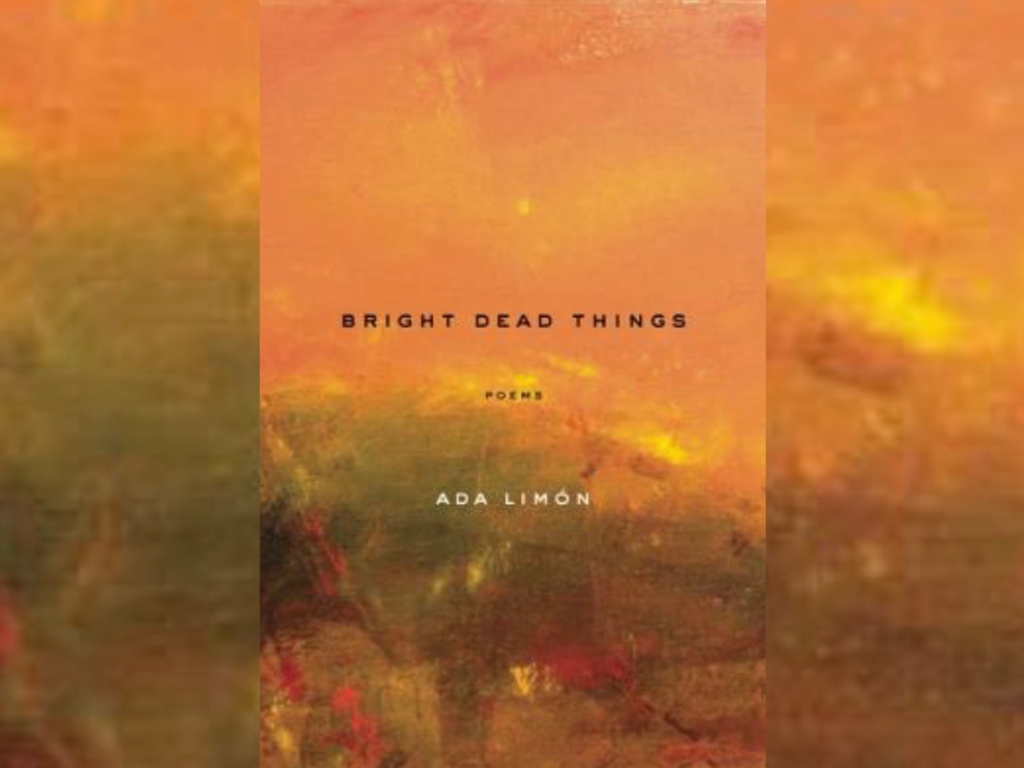
The first Ada Limon poem many people read, including myself, is “How to Triumph Like a Girl.” It’s the first poem in her 2015 collection, Bright Dead Things, which I received as a present for my eighteenth birthday from a childhood friend who knew my taste in literature well enough, but didn’t have to use said knowledge on that birthday. I had explicitly asked her for it, in unambiguous terms, several times. I loved the abstract painting on the cover every time I saw it at our Barnes and Noble: dry, olive-green brush strokes towards the bottom beneath a layer of orange punctuated by yellow streaks, like a forest on fire. Its abstraction seemed to suggest literary importance. It was the kind of book cover I felt would metamorphosize me into an adult.
I read “How to Triumph Like a Girl” my first week of college, sitting outdoors on a bench on campus, the dregs of early-autumn Texas heat stifling the leaves off the trees. I was emerging from a late-adolescent period in my life in which I was suspicious of accessible or contemporary poetry. My profound and searing love for Sylvia Plath stood in direct correlation to my inability to understand her work. Yet, here was a poem with tidy, intelligible lines, a poem whose power seemed to germinate precisely from its simplicity: The poem begins by lulling you into complacency with its talk of “lady horses,” and the way they make “running 40 miles per hour” as “fun as taking a nap, or grass.” (lines 1-4). But as with so many of Limon’s poems, the volta, or “turn,” for the uninitiated, challenges your expectations of the poem and its lady horses, confronting you with its “8-pound female horse heart/ giant with power, heavy with blood.” (lines 12-13).
Sitting on that bench between the student center and the education building, I was thronged by anonymous freshmen commuting to their next classes, none of whom were the wiser that at that very moment I was experiencing the first hot thwap of a female horse heart.
In preparation for Ada’s visit to Texas State, I had my students read both “How to Triumph Like a Girl” and “The End of Poetry.” I teach first-year English to a group of shy, polite, sometimes apathetic eighteen year olds– kids who, rather than choosing to be in an English class, were likely automatically registered for it by an academic advisor. They, like me, have grown up in rampantly anxious times, an era racked by the threats of climate change, culture war, genocide. An era in which, like “The End of Poetry” affects, one feels they’ve had enough “pointing to the world, weary/ and desperate, enough of the brutal and the border.” (lines 15-16). It’s precisely because of my student’s general disinterest in literature that I’ve been grappling with the question of what it means to be a good steward of poetry for young people encountering it for the first time. In search of an answer, I signed up for a seat in Ada Limon’s one-time afternoon workshop this semester. I’m finding that most of my questions around teaching can be answered by returning to being a student.
Months before meeting Ada Limon, I hiked through a nature walking trail near my apartment complex listening to her interview with Anna Martin for “Modern Love.” Towards the end of the interview, she talks about the difficulty of writing towards happiness and gratitude, saying it’s often easier to “plummet to a bottomless pit of despair” than it is to “choose life.” This surprised me. I’d always understood Ada Limon as a poet of domesticity, small epiphanies, grief and rage often couched by sparks of levity and bird song. A poet whose work “chooses life.” Learning more about her experience as a writer makes my impression of her work a testament to her talent: she is always doing the hard thing.
At the Katherine Anne Porter House in Kyle, Ada sat at the head of a long mahogany table. She was a bright, smiling woman who, like so many poets I’ve met since starting graduate school, was wearing large earrings. As students arrived and took their seats, she chatted to us about her month of traveling, joking with us about how the two seats next to the workshop leader always remain empty because every student is wary of getting too close.
Before we started, she called herself a stickler for fairness and produced a kitchen timer which she would set for eight minutes per writer. (A blessing, as anyone who’s gone towards the end of a workshop session knows.) Her approach to the workshop was both methodical and deeply compassionate– from the start it was evident that this was a person who took the work of understanding our individual visions seriously. A highly skilled artist with meticulous, line-level suggestions for strengthening diction and syntax as well as someone who believes that the job of a workshop leader is to respect the dignity of the work we’ve all come together to produce. As always when participating in a good workshop with good people, I felt my optimism for the power of literature as a force of good in the world unfurling. I submitted a love poem about my partner (a piece which in the past I might have referred to as a poem about the complexities of romantic love or of what it truly means to know another person, but I’m old enough to call it what it is now: a Love Poem) which I wrote while thinking of another Limon poem I love: “What I didn’t Know Before,” in which “A horse gives way/to another horse and then suddenly there are/two horses, just like that. That’s how I loved you.” (lines 5-7). This is what a workshop can feel like sometimes– a love affair, something which gives way to more of itself, strengthens, and populates a whole field with horses.
In terms of my questions about reading poetry with my students, I’ll say this: What makes Ada Limon a revelatory teacher is that she’s the kind of person who says things like “I can’t believe we all just get to sit here and talk about poems,” like she can’t believe her luck. Neither can we.
Works Cited
“Ada Limón.” Washington Square Review, https://www.washingtonsquarereview.com/ada-limn.
Accessed 22 Oct. 2026.
Limón, Ada. Bright Dead Things: Poems. Milkweed Editions, 2015.
Limón, Ada. The Hurting Kind. Milkweed Editions, 2022