“Like a Sport”: A Conversation with Moctezuma Seth Gonzalez, Owner of Livra Books
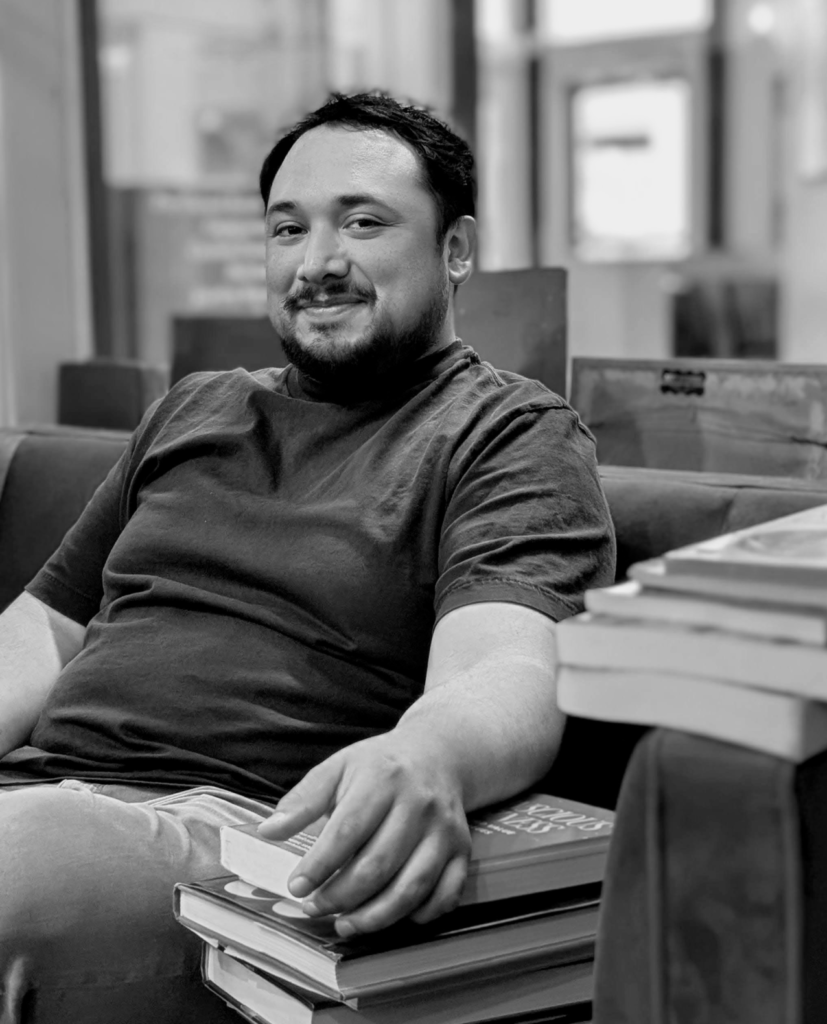
Beloved among the Austin literati for his leafy backyard book sales, Moctezuma Seth Gonzalez is a used and rare bookseller and the owner of Livra Books in Austin’s Hyde Park neighborhood. I sat down with Moctezuma to ask about his unconventional path into bookselling, the thrills of rare book hunting, and how being in this world has influenced his own writing aspirations.
India: How did you get into the business of buying and selling used books?
Moctezuma: I sold my first book the day Kobe Bryant died, in January 2020. It was Stephen King’s The Outsider. The whole thing started as an idea a few months before that. I had met a group of used booksellers who hung out at this bookstore called Recycled Reads. Usually, whenever people go into a bookstore, they’re browsing, so they move slowly. But these people were pretty agile; they whipped around the bookstore. They were scanning books with their phones, putting some back and taking others. I was curious what that behavior was indicative of, and I eventually learned they sold books.
At this point, I had stopped an architecture program and didn’t really know what I was going to do. I knew I wanted to write, but I didn’t know how I was going to make money. I didn’t have a job, I’d met these people doing this strange but interesting thing, and then the pandemic hit. So I decided to try it.
And once I got into the flow of it, I became pretty good at it. It became kind of like a sport. It’s surprisingly competitive and fast-paced. Sometimes aggressive even. But I really liked it, and I just wanted to beat everybody around me.
I started mapping out a plan to get every single good used book in Austin. I learned the locations of all the Goodwills and thrift shops. I figured out when new books were put out. I did that for about a year…Now, I usually buy entire book collections—usually between one thousand and six thousand books at a time, once every three months or so.
India: How did you transition from used books to rare books?
Moctezuma: After a while of doing these rounds at thrift stores, it got boring. A lot of the books sold well, but they were things I hated to look at and never wanted to read. I just wanted to get the money and buy something else.
And so, now that I had more money, I started looking at auctions for rare books. Around 2021, I went to the New York Antiquarian Book Fair for the first time, and that’s when I realized how much more fascinating that world was. There were some really cool, expensive books and oddities.
Slowly, I started learning how these rare book dealers operated, which is very different than the dealers at Recycled Reads. These rare booksellers were looking for nuance and historical significance…I began learning how the market worked, getting a sense of what institutions, like libraries with special collections, were interested in. I realized I could probably source a lot of books in Latin America, because most dealers avoided it due to the language barrier. But I speak Spanish.
My first trip to Mexico City didn’t yield much, but I learned a lot. I met a bookseller who owned seven bookstores there, and he introduced me to the places he would go—these bazaars called tianguis, basically huge open-air flea markets. That started me down a path of acquiring, pretty cheaply, some really cool stuff.
India: Can you tell me more about what makes a book “rare”?
Moctezuma: It’s a combination of desirability and scarcity.
Scarcity is straightforward: how many copies exist. Desirability is like a dial. You can increase a book’s desirability by, for example, finding the significance of the item and tying it to a historical moment. You can take an obscure and unknown book and make it into something interesting by creating a narrative of its significance within history.
India: Can you give us an example of that?
Moctezuma: There’s a bookseller who acquired a moderately rare book, but then they identified that the spine of this book was embedded with scraps and fragments of another really rare book. In the past, printers would make errors, and they would use scraps of other books to patch up the book’s spine to reinforce it. So here’s this book which was probably worth tens-of-thousands, and suddenly it becomes a $200,000 book. All because of the research this guy did to figure out the embedded scraps.
Then there are books that we have multiple copies of. The most expensive book I’ve seen at the Antiquarian Fair is a copy of Copernicus’s De revolutionibus orbium coelestium on heliocentrism. It’s priced at $2.5 Million. There is more than one copy of the book, but because it’s historically significant, it can demand that price.
And then there are books that are one of ones and not that valuable. I have a Bible that belonged to a German immigrant in the 1830s. Inside, his name’s written, and it shows where he’s from in Germany, and then how he moved to Fredericksburg and around Central Texas. And you can even find his grave. It’s a one of one. It’s rare, but not particularly desirable. I think I’m selling it for $200.
India: What’s the rare book you’ve found that excites you most?
Moctezuma: I found a really cool Introduction to Philosophy book in Mexico. It was written by the Spanish philosopher José Gaos, but what’s really cool is that it belonged to one of his students, Jorge Portilla, who went on to become a well-known philosopher himself.
Portilla wrote his name on the inside, and he has all these notes of him thinking through the text. You’re seeing a young Mexican philosopher dealing with Gaos’ ideas in real time. So it kind of falls in manuscript territory. The book is also signed by Gaos.
I’ve mistakenly sold valuable things for very little money. There was a signed copy of Beloved by Toni Morrison that I accidentally sold for $7. The only reason I found out about it was that a customer came into the shop asking for signed books, and I pointed her to the rare book room. And she said, “Do you have another Toni Morrison signature for seven dollars?” And I was like, “No, I would never have that for seven dollars.” And she said, “My friend came in here the other day and paid seven dollars for one.” And I said, “Well, your friend got very lucky.” I thought it was hilarious. Frankly, I’m much happier with a customer winning in this regard than another bookseller. If a bookseller wins, it burns a bit because it’s like, “Oh, I missed that?”
India: From the outside, the rare book world seemed to me to be a pile of dusty books. But you made a comparison earlier to book hunting being like sporting, which I’m starting to understand. What is the culture of this world like?
Moctezuma: The rare book world can be kind of snobbish. It used to be a gentleman’s activity. It was usually done by people who had means, because the trade requires such a high capital investment at the start. If you’re going to sell a book for $25,000, then you probably paid $22,000 for it. Those booksellers can afford to sit on that book for two, three, four years. I don’t have that luxury. So I’ve witnessed this weird dynamic where new booksellers come in and are excited about a book they’ve sold for $500, but to established sellers, that’s nothing. Fortunately, I haven’t had to deal with that snobbery much since most of the rare book trade is on the East Coast.
And now that I have a shop, people come to me with material, so I’ve been able to acquire some cool things.
India: What prompted you to open a brick-and-mortar store?
Moctezuma: Opening a bookstore wasn’t even on my radar. Then I held a backyard book sale in December 2023 and this gentleman offered to invest if I ever decided to open a brick-and-mortar. I reached out to him later, but no response. By that point, though, I’d already started looking at retail spaces, and eventually I realized I could just do this on my own. I found this space, and officially opened in September 2024.
Beginning with the backyard sales, I had started building a community. People were starting to recognize me on the street, which was fun and weird. And that’s been a huge plus of all of this. It makes me consider Austin more of a home because I’m now kind of embedded in it, specifically Hyde Park.
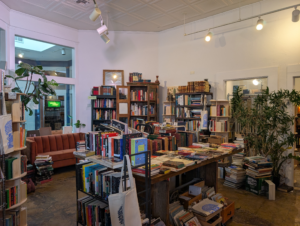
Livra Books opened in September 2024 in Austin’s Hyde Park neighborhood.
India: Can you talk more about that community aspect? You started an anti-brain-rot book club and you do all these other events. Why is that important to you?
Moctezuma: It started off with a belief that bookstores have a certain responsibility towards the reading public, that they should do more than just sell books, or at least do it in more curious ways. I think bookstores should facilitate space for people to discuss books. Book clubs aren’t profitable. I never expected them to be. But I wanted to be a store that seriously appreciates literature, and that means an excessive amount of book clubs. Like it’s unreasonable the amount of book clubs I have.
India: How many books are in the anti-brain-rot book club?
Moctezuma: At least 122. Sometimes we have five book clubs a week, like this week.
India: How do you manage that all?
Moctezuma: I tell people not to expect expertise from me. I’m reading a lot of these books for the first time. I’m not necessarily capturing anything deeper than what they’re capturing. But whenever you’re in a book club, there are things that spark for some people, and different things that spark for others. Together, you start to fill in blanks. In isolation, you can only capture so much. But in a book club, you fill in the void of information or understanding.
India: You’re also a writer. What are your writing aspirations? And how have those aspirations changed since becoming a bookseller?
Moctezuma: I probably quote this anecdote from Henry David Thoreau too often. He talks about a basket weaver who goes out, makes a basket, brings it to market, and gets upset when nobody buys it. Thoreau’s point is that the basket weaver didn’t stop to consider whether it was worth anybody’s time or interest to buy this basket.
There are a lot of writers out there self-publishing, being their own editor, publisher, saying, “This thing I’ve created is gold. It’s going to change the world.” And maybe it will. But there’s such a glut of material out there that just isn’t needed.
People say there’s a book in everyone. There might be, but it’s probably not a very good one. So yeah, I don’t think everyone should write a book now. I do have aspirations to be a writer and write. But I’m also of the mindset that if it’s not good, then it’s not any good. If I spend years working on something and craft it as best as I possibly can, and in the end it still isn’t any good, then it’s not any good. It’s not the end of the fucking world.
I think if I’ve enjoyed the process, reading voraciously, writing until two in the morning, but it doesn’t become what I see in my mind, then that’s okay.
India: Do you ever get discouraged from writing when you think about how many books already exist in the world?
Moctezuma: There are moments when I have. Sometimes I think it’s so sad that this person dedicated ten years of their life to write this thing, and now it’s on my bargain shelf.
But I want to think that the person who wrote it found pleasure in doing the work, and maybe they were compensated in some other way, like through a teaching position. And it brings me to the point of doing something independent of whether it makes money or not. There’s something beautiful about that.
If you can accept that nothing may come of your work and you still want to fucking write, then you probably should continue doing that. I’m not going to not write. I’m still going to do it. And we’ll see if it comes to anything.
This interview has been edited for clarity and length.