A Conversation with Clark Finalist Sanjena Sathian
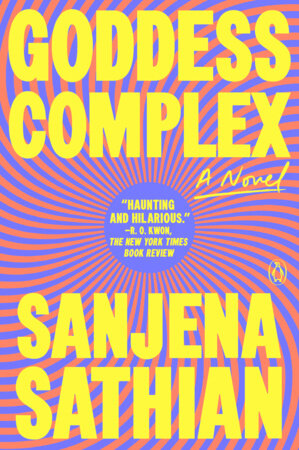
Sanjena Sathian’s second novel, Goddess Complex, is a vibrant, smart, genre-bending, identity-interrogating, and often pleasurably bonkers. Goddess Complex follows Sanjana Satyananda, a graduate student whose efforts to forge a new identity in the wake of her divorce take her from India to New York City and back again, and through the crucible of cultural reproductive surveillance, the beguilements of threats of planned community, and the twin panopticons of Instagram and her own unconscious. In this conversation, Sathian addresses the novel’s shifting premises, its conflicted relationship with genre, and why comedy is a form of realism.
Jd: What I admired most about Goddess Complex was its smart, sly, utterly surprising shifting of its own terms—narratively, tonally, etc. I was particularly struck by the book’s evolving relationship to realism itself. Can you share a bit about how those variations showed up in the drafting process, and how you ultimately harnessed them into a trajectory?
SS: I am so glad that the protean nature of the novel appealed to you, because that was both the joy and the challenge of writing it. Every time I thought I knew what it was, it surprised me. The book began as something so autobiographical I actually thought it might be memoir. I was trying to capture the experience of losing oneself in a relationship. The declining marriage between the narrator, Sanjana, and her husband, Killian, sat at the center of the novel; I was thinking a lot about Daphne du Maurier’s Rebecca, from which I take the book’s first epigraph. But as I wrote, I found that premise increasingly constricting. I was interested in the self, but not as narrowly defined by a single marriage. I wanted to understand who Sanjana was in that marriage, yes, but also after and apart from that marriage. Understanding this character required me to do more than draw on my autobiography. I also had to invent. I wrote my way out of memoir, toward autofiction, and then past autofiction to something else entirely. I think of the book as a work of uncanny fiction. Is that realism? I’m not sure. It was true to my reality.
Jd: Your narrator is named Sanjana Satyananda, which inevitably invites us to consider the question of whether Goddess Complex is to be understood as a work of autofiction. Many readers will probably initially conclude that it is. But this understanding turns out to be yet another premise the book ultimately complicates and iterates upon; in this way, Goddess Complex felt like a work of post-autofiction. I’m curious how you were thinking about autofiction as a genre, and reader expectations about it, as you were writing.
SS: I love this idea of post-autofiction. I think Goddess Complex might also be pre-autofiction? Or not autofiction at all? I’m not sure. I know that I’m interested in the infinite possibilities of first-person narration, including and apart from autofiction. My first novel, Gold Diggers, is also narrated in first-person, and in that book, I played with what I call first-person-omniscient, borrowing from writers like Philip Roth and William Styron; I let my narrator tell other people’s stories when he needed to. There, the first-person narration needed to sprawl; I was telling a big story about immigrant experience and so my narrator had to get outside his head. Here, the first-person narration needed to encounter something strange, something feral.
There are so many ways to use the pronoun “I” in fiction. I love the work of many autofiction writers such as Rachel Cusk and Ayad Akhtar. I love the confessional first-person quality of writers like Sylvia Plath and Jamaica Kincaid. I love the metafiction of Roth and Kurt Vonnegut and Susan Choi. I love the storytelling first-person voice that draws on mythic narration, which we find in the work of writers like Herman Melville and Salman Rushdie. So I was thinking of all of these “I”s, not just the “I” of autofiction.
I think the magic of all fiction is that it can say something deeply personal and subjective—it can make us understand these fleeting moments that mean nothing to an outsider but are the molten stuff of selfhood. But it can tell that highly intimate, subjective story while also reaching toward a wider tale of society, of interconnection, of universal human experience. No matter the nature of the “I,” it’s ultimately a route into the “we.”
Jd: You have observed elsewhere that “women often suffer in communitarian societies.” In Goddess Complex, you explore this theme within the context of planned communities in India, as well as within an individualistic American culture in which women are nevertheless subject to intense societal scrutiny of, and sense of collective entitlement to, the details of their reproductive lives. Can you discuss the parallels and differences you see between Sanjana’s experiences in communities (particularly predominantly female communities) both before and during her return trip to India? Were these connections, and your skepticism about possibilities for women within communitarian societies in general, ideas that preceded your writing Goddess Complex, or that emerged through drafting?
SS: I didn’t write Goddess Complex as an intentional critique of communitarianism; that’s just an idea that must have been in the back of my mind as I drafted. You’re right that Sanjana feels pressure in a lot of different social contexts. The individualistic nature of American society means that Sanjana is increasingly isolated from her friends as they all couple up, buy homes, and start traditional families. But the communitarian nature of her Indian family means that Sanjana is expected to be a certain kind of dutiful daughter, sister, aunt, et cetera. Neither model is great; both are restricted by certain norms.
Like many queer and feminist writers, I’m curious and skeptical about what norms hold the world together. Why are we so attached to reproduction and procreation? What hold does the heteronormative nuclear family have on us all? How can we create alternative modes of kinship and belonging? But even as I am constantly asking these earnest, almost utopian questions, I also have to leaven them with critique. If you, like me, are prone to wondering about other ways of being, you might also be liable to join a cult. And I am a millennial who spent my twenties in San Francisco and India around a lot of cultish organizations, many of which shaped the various communities I sketch in Goddess Complex. So this novel, like all my work, is trying to hold both hope and skepticism—to suggest that there must be other ways of being, and also to laugh a little bit at the tragicomedy that often results when we try to create those other ways of being.
Jd: You’ve spoken in interviews about your own sense of realism, which is informed by the notion that reality itself is often outlandish (as you quote Salman Rushdie saying, “reality is unrealistic”) and absurd (“comedy is realism”). In a way, it’s books that are entirely self-serious, devoid of playfulness or irreverence, that are the deviations from realism—yet I don’t think this is a widely-held belief. Why do you think so many readers (and writers) perceive realism in literature as inherently more solemn and less unusual than realism in real life? Do you have any favorite overlooked books or authors that commit to comedy as realism in the way that Goddess Complex does?
SS: After I published my first novel, which is semi-comic much as Goddess Complex is, an Indian uncle came up to me at a party and advised that I write “something serious next time.” It was absurd; there are very serious things in that first novel, just as there are in this one. What had made this man think that a wry tone cheapened the work? There’s no accounting for taste, but I wonder if it has to do with this buttoned-up idea people have about books—that they’re for classrooms, they’re dusty, they’re old. Something fun couldn’t possibly also be good for you. Of course, so many of our greatest writers understood comedy as part of the pantheon of realism. Madame Bovary is a very funny book; I particularly recommend Lydia Davis’s translation. Gogol is a riot. So is Kafka. So are Roth and Shirley Jackson and Rushdie and Zadie Smith and Hanif Kureishi and Paul Beatty and Percival Everett and so on. As for overlooked writers, I teach the eighteenth-century Chinese writer Pu Songling, whose ghost stories in Strange Tales of a Chinese Studio are incredibly funny. Contemporarily, I think of Karan Mahajan, whose first novel is a classic comic novel; his latter two are perfect blends of tragedy and comedy. I also love the work of Alexandra Kleeman, Sayaka Murata, and Laura van den Berg, all of whom I think balance comedy and strangeness to create a realism all their own.