Primal Connection: A Conversation with Mai Der Vang
Primal Connection: A Conversation with Mai Der Vang
When Mai Der Vang was growing up in Fresno, California, her mother talked about an “animal with horns” that lived in her native Laos. Years later, Vang learned that this animal was called saola. In 1992, the World Wildlife Fund announced the discovery of saola in the Annamite Mountains, making it the first large mammal to be discovered in the region in 50 years. In her recent poetry collection, Primordial, Vang explores themes of inheritance, motherhood, and her lifelong fascination with this animal.
An Associate Professor of Poetry at Fresno State University, Vang is the author of two previous poetry collections, Yellow Rain and Afterland. Her poetry has received many honors, including the Lenore Marshall Poetry Prize from the Academy of American Poets, an American Book Award, finalist for the Pulitzer Prize in Poetry, and the First Book Award from the Academy of American Poets. This fall, Vang served as the Endowed Chair of Creative Writing at Texas State.
SO: Tell me about the origins of Primordial.
MDV: The first time I learned about saola was when I was quite young. I didn’t know much about my parents as refugees. I didn’t understand much even about who I was as a Hmong person. I had little to no context for my own history, though I did know they came from Laos, and it was a very different landscape.
I remember my mother mentioning at one point something about an animal with horns. And that was all I remember. Locals had long known of the saola, but it wasn’t until about 1992 that the rest of the world knew that saola existed, and it was considered one of the great zoological discoveries of the century. To think there was this large animal living in this space, undetected by the world, was astonishing. Later in my life, when I joined a Hmong writing collective, one of my friends talked about this animal named saola, and it triggered something for me. I said, “that’s the animal with horns.” That’s also when I learned saola was and is endangered.
SO: I was thinking of the saola as small because it’s hidden and hasn’t been seen often. But you do write that it’s bovine . . .
MDV: Yes! It’s about the size of a white-tailed deer. It’s a rather large animal when you consider that other animals being discovered are insects, frogs, rabbits, or turtles. Animals are continually being discovered in this particular region, the Annamite Mountains, even to this day. I believe they just recently discovered a new species of leaf monkey.
SO: Did you plan to write a whole book about saola or did you just find that you had a lot of poems with saola in them?
MDV: I didn’t have any poems that I had written specifically for saola, but saola’s name would appear in some of the poems. At the time when I was writing those poems, I didn’t feel ready to pursue a book about an animal that I was still exploring my connection to. It wasn’t until I got through two books of poetry that I felt like I could dive deeper and commit to sharing and exploring that kinship.
SO: When you say “dive in deeper,” do you mean like the research that you did?
MDV: Right, exactly. I spent time reading scholarly articles. I connected with a conservationist and reached out to an NGO doing conservation work for saola. I wanted to connect with people who were doing real, life-changing work for this animal. It opened up a whole new world for me. I have no training as a biologist or a zoologist, but I love learning, and I love exploring the ways these interdisciplinary connections can enrich my poetry.
SO: When did you begin to think of yourself as a writer and a poet?
MDV: I don’t think there was a defining moment when I thought, “Oh, I’m a writer!” It just happened over the course of writing these books, studying poetry, and applying myself to the practice of it. The more I practiced and it became part of my everyday life and my outlook on life, the more I felt like I could call myself a poet. I think it has to do with the willingness to muddle through language and labor with words.
SO: Did you get your MFA right after college?
MDV: I did not! I took nine years off, almost a decade. After my undergraduate degree, I went back home and spent time doing community work. I volunteered. I coordinated for community-based organizations, worked with youth groups, ran workshops at juvenile hall. I didn’t have anything figured out. I didn’t even know I wanted an MFA. It wasn’t until much later, when I connected with the Hmong writing collective, that I started to take my writing seriously.
SO: And when you wrote during that time, was it always poetry?
MDV: It was. I started with poetry. One of the local organizations I worked with was an ethnic media organization, so I also wrote occasional essays and op-eds, and that helped me to hone my voice and perspective.
SO: I’m stuck on that phrase, “muddle through language,” because it makes me think of you growing up in a house where English was not the primary language. I imagine muddling through language was a big part of your life growing up.
MDV: Absolutely. English is not my first language, and I grew up in a multi-generational household hearing the Hmong language. My paternal grandparents lived with us, and after my grandfather passed my grandmother lived with us until she passed as well, so we had a multi-generational household for decades. The Hmong language was the primary language and the center of my understanding about how to communicate.
Part of my journey with poetry has been the act of muddling through language. And in that act of muddling, finding out where I can situate my voice. How far should I lean into one, and how do I bring a balance to what it is that I want to say but do so in a way that recognizes my first language, Hmong.
SO: That reminds me of the poem with the word shapes that look like moving clouds, “I Understand This Light To Be My Home.” Can we look at that one? It’s so intriguing and beautiful. These clouds remind me of birds flying through the air . . .
MDV: Murmurations!
SO: Yes, murmurations of starlings, and also the sun rising. But what were you thinking about?
MDV: When I wrote this poem originally, I did not have the visual elements. I had the draft of the text, and I thought, this is such an unusual poem. What am I saying? Whose voice have I embodied? I don’t know if it’s even my own. I felt transported. The poem feels otherworldly to me, and I just kept going with it, with this voice seeking something unattainable, something far above and out there, way out in the universe where a connection is felt and yet the speaker is unable to fully explain that pull.
The visual elements were added much later when I was experimenting with how to present the poem on the page. I was playing with the words “light” and “language” and as I manipulated them on my screen using Adobe Illustrator, I ended up cutting and pasting the words and superimposing them a hundred times over themselves, so much so that it almost felt like a light was growing brighter. I wanted to create this feeling of light when you flip the page and a kind of animation effect that you might sense as the gradient gets darker. You could think of the light as getting brighter, or that the light is dimming and the dimming is growing stronger.
SO: It’s very effective. It reminds me of that part in Genesis:, “in the beginning there was the word, and then God created light.”
MDV: I didn’t even think of that, but I’ve heard someone else share a similar reference.
SO: What about motherhood? When did that happen in relation to the book?
MDV: I actually wrote a lot of these poems during my postpartum period, which, as I’ve told some readers, I would not recommend. But it was a time when I had entered a new sort of emotional state, a new way of being. The rhythm of my life completely changed; it was flipped upside down now that I had this new little human to care for. The weight of that, the stakes involved, also transferred to my poems.
SO: In one poem, you write about a saola giving birth. In another poem, the saola stands in for you as a child. Did becoming a mother make you feel differently toward the animal?
MDV: Absolutely. It had to do with this strange feeling of having just brought something into the world. And on the flip side, knowing this animal is struggling to continue to bring something into the world. The complication of my existence complicating this animal’s existence, I felt that quite a bit in writing these poems.
SO: There is one poem (“Beast You Are Who Calls to the Beast I Am”) that I really identified with in how it feels postpartum, where you are experiencing the animal in yourself. I think motherhood brings out the awareness that we are all animals.
MDV: Yeah, absolutely. As a poet, I often feel a primal connection to something unknowable that came before me, and whether it’s obvious or not, it seems to me it’s what makes me or anyone else as much a creature as an animal.
SO: I’d love to ask about how you order the poems in this collection. What was your thinking?
MDV: The first poem (“Animal”) came much later, when I was still reaching for what the book was going to be about or where it was going to go. I kept coming back to that first poem because sometimes what I’ll do, especially with the first poem, is write that poem to embody the tone, voice, and overall ambience that I want to create for the book. And once I’m able to wrangle that poem into a shape or voice or structure, it feels like I’ve taken a weight off my shoulders and all the other poems can follow.
The ordering of collections is always a strange and evolving experience because it changes with each book. I never know where it’s going to go. For practical reasons, I do make an inventory of the poems I would like to write, which helps me stay organized. As an example, I knew I wanted to write a poem about the flora and fauna of the Annamite Mountains. I wrote the poem, and then I came back to revise it much later. I continue in my process like that, exploring what poems are needed, what poems will anchor the collection. And once I’ve done all the poems that I think I might do, I lay them out on the floor and have this big mess—
SO: Literally on the floor.
MDV: I did that with this book, yes. It helped me see if I had too many poems on this, or not enough on that, or if a poem was too much or too intense, I could see then where I might bring in a moment of lightness or levity. The sections are not clearly lumped by theme, but I did want to start out in the beginning offering a sense of saola to the reader.
SO: It felt like there was a logical sequence, because in the beginning we learn what the saola is, and by the end we know the saola, we love the saola, and we can begin to understand the saola as a character in these narratives.
MDV: That’s what I hoped for! Motherhood doesn’t get introduced until midway through the book. I wanted to devote the early space to saola. Like you said, to help the reader learn to love the saola as much as I love the saola and to proceed in the journey of this work with me.
SO: The poem, “Evolution Absence,” feels like a turning point. Almost a hinge. We’ve been learning about the speaker and the saola, and here is where we start to understand the saola in relation to the Hmong people.
MDV: I’m glad that came through. I knew at some point in the collection, I wanted to offer to the reader what was at stake—not only that the saola is endangered—but what is at stake for me or for the speaker in these poems. It led me to the connection of the Secret War and the Hmong people’s experience as refugees. Running, hiding, and fleeing.
SO: This poem has a starkness and a strength to it that I really like.
MDV: Thank you. This one benefited from the simplicity of the language. It’s a poem that builds up as a sequence.
SO: And the Secret War (covert CIA operations involving the Hmong people in Laos) was a larger topic in one of your other collections?
MDV: It’s been in every book that I’ve written, but more in my first and second books. This third book does touch on the War to draw a connection to the landscape and the Hmong experience, but it’s broader and only one aspect of the book.
SO: It’s so sad that writing about refugees always feels timely.
MDV: It does feel that way, yeah.
SO: There are poems in this collection that you call “node poems,” in which the lines extend across the page both horizontally and vertically, almost like a sentence diagram. I’m curious when you started to experiment with the line in that way. How did that happen?
MDV: When I started writing poems for this book, I wanted to try something different. I also wanted to bring some degree of moderation to my approach in contrast to my second book, Yellow Rain. I didn’t want to go overboard and do something that would freak myself or my reader out, though I admit I’m not afraid to do that either. The node poems were my attempt to experiment and try something different but also maintain within the language a semblance of what someone might think of as a poem. I made multiple attempts at these visual structures. Many of them failed. I tried triangles and variations of timelines. I even had one that looked like a sentence diagram of sorts. And then I landed upon this idea of dots and the linguistic enactment of what it would take to disembody a poem on the page while keeping it intact.
SO: Hearing you talk, the word that comes to my mind is diaspora.
MDV: Exactly! There is the effect of a scattering and separation.
SO: Like, how far apart can you scatter it and still have a coherent poem?
MDV: Right. And so for me these poems were a challenge in how to both disembody and embody at the same time. Can I structurally break this poem up but keep its syntax intact? Can I create language within language? Which is what I was attempting with the main throughline.
SO: It feels like you want to challenge the idea of a poem.
MDV: I think so, but more importantly, the node poems were an attempt to challenge myself while helping me rethink how I might approach a poem line by line, word by word. I was also interested in exploring how these node poems might confront or resist the idea of linearity and yet still conform or subscribe to some degree of linearity at the same time. What does linearity even mean in a poem?
And perhaps I’m also thinking about time, not as linear but as scattered. Time as returning to itself. Time as this mess of leaving and coming back and leaving and coming back.
SO: That feels very much like my personal experience of becoming a mother—it very much scrambled my sense of time.
MDV: Exactly.
SO: Are there poets who you admire for their experimental work?
MDV: I’ve long admired the work of Canadian poet M. NourbeSe Philip. Her work captivates and is forward-thinking with regard to language and text and the tensions that one can create within that space to reexamine histories that need to be reckoned with. I take so much inspiration from her work. I also love poets who write about the natural world, and I loved Cecily Park’s The Seeds, and Cyrus Cassell’s recent selected works Everything in Life Is Resurrection. I adore the poets who teach in this program and would count them among my influences.
SO: Where else do you find inspiration?
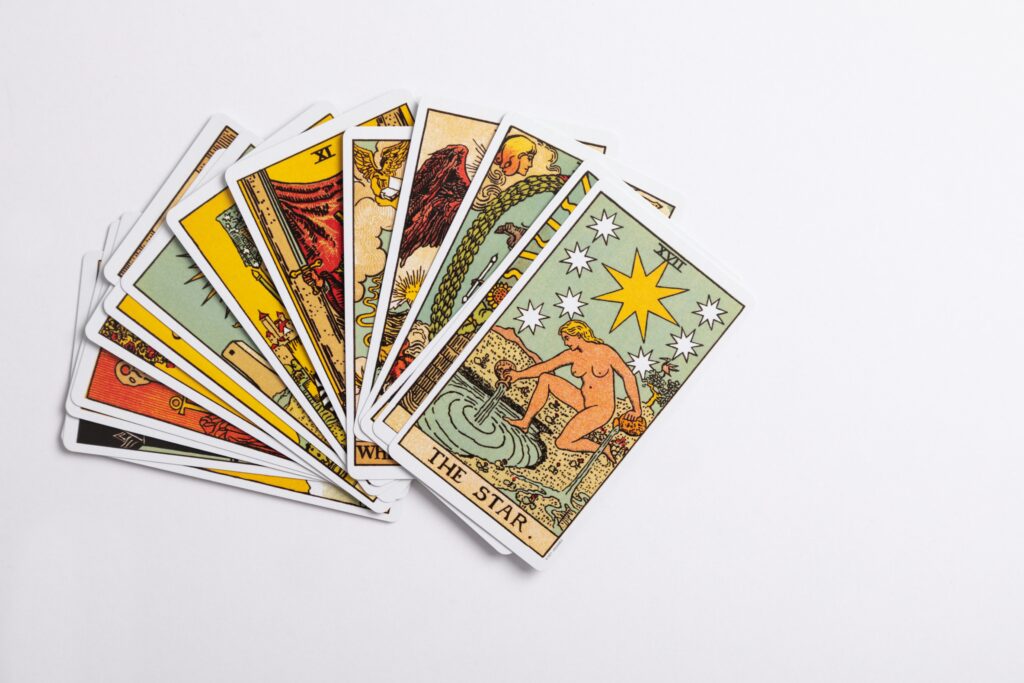
MDV: [Laughs.] I wish I had more time to be a normal person. Right now, everything around me is mommy life. Picture books and toys and just anything that my son is into, we’re all into it. But I will say that as someone who was raised in a family that practices shamanism and in exploring connections to earth-based spiritual practices, I’ve picked up Tarot, and it has enriched my creative practice.
SO: How do you use it?
MDV: It’s both a tactile and psychically-engaging experience. I love feeling the cards in my hands. I love the feel of shuffling them. I love being able to create a narrative out of the cards I’m reading. It doesn’t have to be a high-stakes reading for myself—it can simply be a matter of drawing cards and asking, what is this combination of cards teaching me? What does it mean that they are coming out in this variation? You get a different story every time. Switching out one card is like switching out one word, which can change the entire reading. I appreciate also that you can draw from tarot a range of imagery, symbolism, along with archetypal conformities and nonconformities. It encourages me to keep expanding my own craft and think about other possible variations to my work.
SO: A spread has such a nice shape to it – I can imagine that coming out in your next collection.
MDV: True, I like imagining that possibility and of being open to what comes through. Speaking of openness, I’ll end by noting that I have loved being at Texas State with the students. The students I’ve had the chance to work with in workshop, yourself included, have shown so much heart and openness to the work, and that’s been a real gift to witness.