Why the Caged Bird Sings: A Review of Diamond Forde’s Poetry Collection “The Book of Alice”
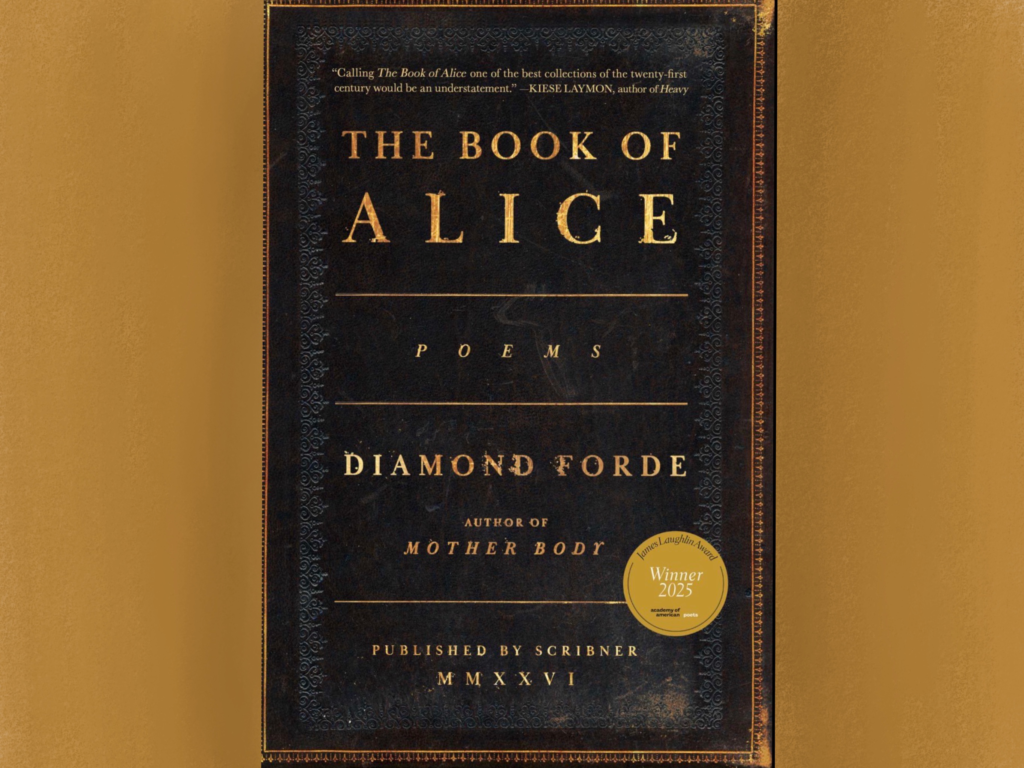
I love it when poetry is an accidental present. When you blindly reach for the shelf and pull out a mirror on your own existence. Diamond Forde’s new poetry collection, The Book of Alice (Scribner, January 2026), is a story of survival, memory, and an elegy to a grandmother whose love and hardship grew from the deep South to the great North and back again. As a child of the Carolina Lowcountry and a descendant of the mountains of North Carolina, I’m partial to songs that reverberate a shared past mired in the complicated history of places we’ve loved. I, too, understand about missing fathers and grandparents who lived downstairs and daughters left to raise children alone. But you don’t have to be any of those things to fall under the spell of Forde’s talent. It sings no matter what your history is.
An assistant professor at North Carolina State University, Forde’s debut collection, Mother Body, explored self-love and self-exploration. Here, she reaches beyond her own skin to write for the women who came before. Exorcised from the King James Bible her grandmother, Alice, coveted, the poems that make up this slim volume are about the “silences of legacy, archival erasure, and the perceived excess of Black female embodiment” that drive Diamond’s writing. Following the story of Alice from girl, to woman, to grandmother, the verse evolves into a song of survival emanating from a grandchild, spilling onto the pages of this luminous gift of words. The book ends with the beginning; notes that explain the origin of this written reanimation, one that centers not just the story of the women in Diamond’s family, but one that is sectioned by portions of the Bible (Genesis, Revelations, etc.), and seasoned with recipes, a family tree, odes to carrying the weight of life in your physical form, a census check, and a “Record of Deaths: Diamond Forde or a Written Apology to Me in a Parallel Universe”.
“Like anyone with an imagination, I grieve
the infinite me, a multiverse
of self thrust through space dust,
& I’ve survived”
In “Creation Myth”, we see Alice’s own words–literal notes and poems scribbled in margins–shown in red like the words of Jesus himself; the voice of a matriarchal martyr nearly lost to time. On these pages, she resurrects a grandfather, building him from the grave up as if recreating his legacy from the ashes.
“6 The first man to ask me to marry him, I will.
7 A mantra hymning a spell, charming the sugar in her
cracked wheat, her boots’ rubber heels, even the dirt sifting
hillsides on the sill. The first man…the-first-man…the-first-
man-I-will, she intoned, till her tongue wept magic, & The
First Man sprouted, watered from the spittle of her wish.”
However, he’s not who the story’s about. The “Origin Story” belongs to the women left in the wake. Not just Alice but every woman meant to shoulder the empty spaces left behind, “because what / did she know about love except the silent corners a man left / when he’d gone”. Women like Joy who regarded him with “the confidence of women / taught to be fruit / on a high branch” and The Daughter, “chucking girlhood like a ticket stub”. When Diamond pens these words in “Poem in Which I Should Write About Cain, But I’m Tired of Writing About Death”, she is screaming from the hidden places of the South, a resounding yawp that echoes over large swaths of green that strangle and beautify in equal parts.
“Someday, when I am not afraid
to think of myself as a god large enough
that every heart-shaped leaf dicing light
to dust could beat in my own chest,
& I’ve never made a life, but I’ve reached
into the refuse they make of us,
found hearts hardy as crocus bulbs,
& in this poem I will plant a world for women
where kudzu climbs & is wanted.”
We see Alice leave the South for New York as part of the Great Migration North, “the stains of Carolina beaten from her shoes/till only the haunting remained”. In “Southern Fried Catfish or How to Disguise a Carolinian in New York”, as so many Blacks/women before her, Alice is born again to the potential and struggle that come with making a new home.
“Naïve enough to still be rich
with possibility, you paced from bodega to bus stop,
clip-clopped in those cheap & squeaky heels
till the blisters popped & the whole block heard
your dogs bark-“
From Alice comes The Daughters, “a black hole gulping up love,” and from there the poet herself, a breathing, living spectacle of riches in “Another Damn Body Poem”.
“17 What I wouldn’t have given then to shed my skin, to
emerge new & pink-gleaming, reach for the translucent shell
of my old self, gatored elbow & pebbled knee–dimpled chin &
fat gut–hapless–how to make her happy except by plastering
her on every page I think is mine–doesn’t every body deserve to feel wanted?”
Diamond’s poems are little treasures. Taken individually, they are small whispers into the secret corners of the heart. Taken as a whole, they are a history of the human condition, of womanhood, and of the guilt, the shame, and the voluptuous passion that is born from hard-won truths and a lifetime of learning who you are. Beyond generational trauma into the lasting echoes of a shared existence: “it is because of you / that I have come here, the two of us, finally ready for home”.
With the familial shadows of Victoria Chang’s Obit and the resounding echoes of the North Carolina transplant Maya Angelo, Forde’s The Book of Alice will surely be on everyone’s “best of” list come December. Angelo’s own words from Why the Caged Bird Sings might map Forde’s trajectory best. “Instead, pursue the things you love doing, and then do them so well that people can’t take their eyes off you.” Our eyes are watching.