I Wrote a Book on Writing at 18. Here’s What I Think of It Now.

I wrote Why Clichés at an age when certainty felt like a skill. It’s a writing advice book in two parts: the first is 100 satirical bits poking fun at contemporary writing trends and the so-called “mistakes” amateur authors make; the second is a corresponding set of explanations at the end of the book that details how to fix these transgressions.
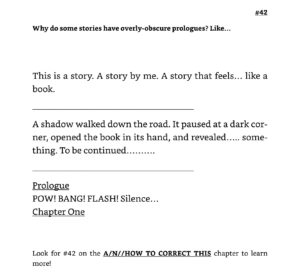
Screenshot
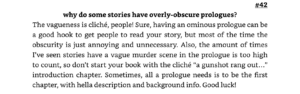
Screenshot
I wrote this book before I’d even graduated from high school. Six years later, I’m in my first year of the Texas State University MFA program. And as I enter the newest chapter of my evolution as a writer, I thought I’d reread Why Clichés and ask myself the question: does it hold up?
But what does “hold up” mean? After all, I’m far from an expert on the craft, despite what 18-year-old Jane thought so very long ago. The only way I can evaluate it, then, is by approaching this as another check-in. Do I still agree with teenage Jane’s (very strong) opinions, or think the structure is still effective after everything I learned as an undergrad? Spoiler alert: the answer—in the same nuanced style of most things that have to do with writing—is partially.
Screenshot
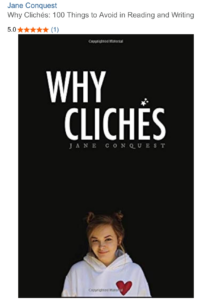
Why Clichés as it appears today on Amazon.com (paperback and Kindle eBook edition).
A bit of context: I started Why Clichés when I was 16, and posted public updates to it on a free writing website, where it eventually amassed almost 8 million views. When I was 17, a dispute with the platform resulted in the deletion of my profile and everything on it. Thankfully, I was able to salvage the book via Google Cache—the majority of my other work was not so lucky. At 18, I self-published Why Clichés via Amazon’s Kindle Direct Publishing.
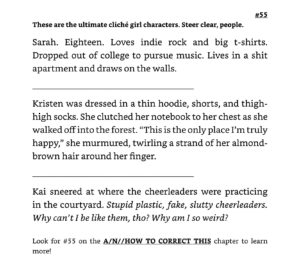
As I started college—and as my frontal lobe began cooking on high—I pulled Why Clichés off of Amazon for almost two years. I was horrified at the idea that I had undertaken a project relying on expertise at such an early age. I ended up privatizing the book after rereading it and being repulsed by how mean it is:
Screenshot
For someone who ended up minoring in Women’s Studies, discovering something semi-misogynistic in my own work was especially disheartening.
It was only recently that I reluctantly republished it, telling myself that if nothing else, it’s a checkpoint in my career—a snapshot that reflects my thoughts during a certain time, and not my current outlook or perspective.
Now, at 25, it’s difficult to dispense with the instinct to make fun of such an audacious task, compounded by the fact that the entire premise of the book is based on ridicule. Teenage Jane was much less concerned with offending people or being unlikable as I am now. The primary hindrance to my current writing process is those two things. My confidence bottomed out from under me as I was exposed to more of the writing world.
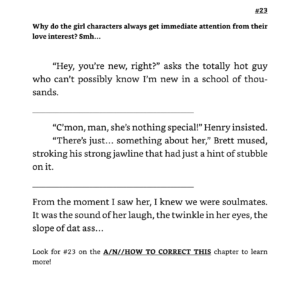
But as is the case with the rest of my books, whenever I reread them, they’re not nearly as bad as I’ve built them up to be in my head. While I was revisiting Why Clichés, I found myself laughing out loud—a mix of laughter and tears, because I’m reminded that I’m still so similar to my past self in so many ways, even if I’ve grown up a great deal:
Screenshot
In my opinion, the essence of comedy is surprise.
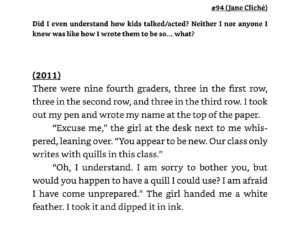
The satirical section of the book is softened by the addition of ten “Jane Clichés” at the end, wherein I critique my own writing from when I was in elementary school. This was a solid choice to show my reader that I wasn’t above criticism, either. It also lends a certain credibility to my so-called expertise by contrasting those early stories with how my work had, indeed, significantly improved:
Screenshot
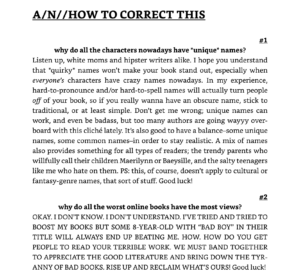
Unfortunately, directly after this rare moment of self-reflection and self-awareness, the second half of the book (the “How to Fix This” section) begins with an equally scathing derision as the satirical parts:
Screenshot
One unintentional side effect of such a strong voice is that this sounds like a teenage girl, and thus immediately undermines its offensive effect. My close cousin is 17 now—the same age that I was when I wrote the majority of Why Clichés—and the concrete firmness of her opinions is both astounding and infinitely fascinating. She is sure that how she feels is both completely black-and-white (that is, that everything can be sorted into neat categories of “good” and “bad”), and also how she will feel forever. Why Clichés functions the same way—it allows little room for nuance, because that would both diminish the humor and, in my teenage mind, undermine my credibility. Of course, the main lesson one takes away from a college experience, I think, is that credibility is maintained by an open-mindedness to learning more.
I remember my dad sitting me down and warning me that some people might take offense to my book. I looked him in his eyes and said, “Obviously.” Writing online creates a sort of armor around oneself, bolstered by the idea that many negative commenters are just commenting to project frustration in their own lives, and the well-supported idea that most people online are crazy. Social media today is also ten times more dangerous than it was back then, due to the debut of AI and the advancement in technology that not only allows harassment but encourages it.
Thinking back on this conversation with my dad, I feel a sense of yearning for that armor, which I shed along with my confidence in my writing. For my entire life, I’ve centered my work around my audience, and now that practice is coming back to bite me in the ass.
The majority of my early writing career was spent entirely online. From posting my books to my 108,000 followers to then self-publishing four of my 12 novels on Amazon—almost everything I’ve ever written has had a reaction to it. I always used to consider this a benefit, because instant feedback meant the ability to rapidly improve the quality of my work. When that dopamine mine of readers bottomed out from under me, too, I found myself speaking to a void for the first time. So Why Clichés is also a revenge story, to prove to myself that I could succeed without my platform, and a recognition of the new humbling that came with that massive loss.
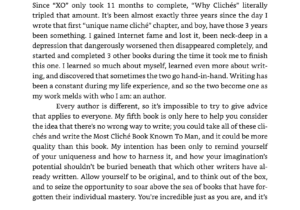
The very final “cliché” of the book sums up this entire meta-experience in itself. It’s a reflection on the process of creating all of the books I’d written up until then, including Why Clichés. It quite literally says, “…there’s no wrong way to write a book”, which is hilarious, given the lengthy critical book that precedes such a line.
This ending is exaggeratedly conceited and then exaggeratedly vulnerable, which is why it works. My strategy was to overshare—to let my audience in on the most deeply personal part of myself: my writing—in order to support my final assertion:
Screenshot

The spirit’s there, I think, and therefore, so is the nuance. In fact, rereading this felt emotional, because it was as if teenage Jane was trying to tell mid-twenties Jane to simply be brave. To rebuild the armor and write.